Skip to content
Request form open 24/7 · Request a Quote
Glasgow Drain Unblocker logo
Written by Glasgow Drain Unblocker Last updated
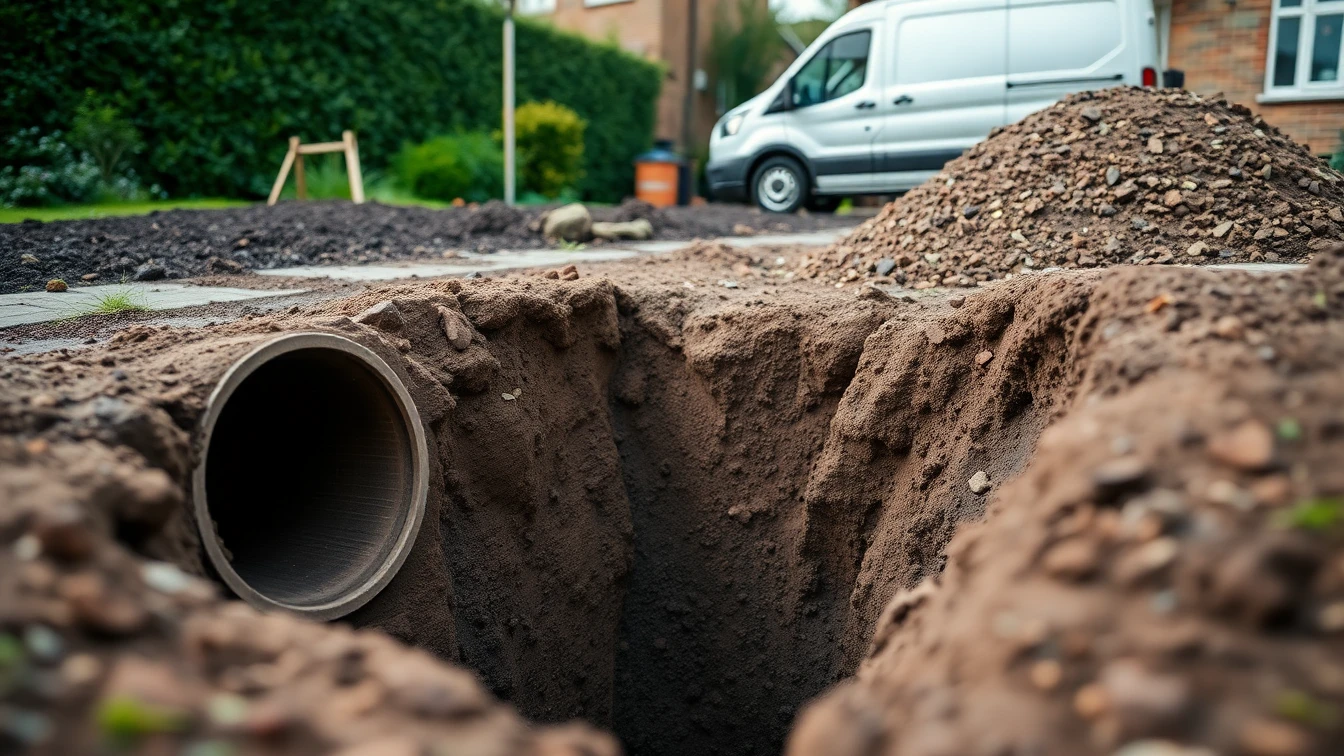
Drain Excavation in Glasgow, a drainage engineer at work
Drainage help across Glasgow

Drain Excavation in Glasgow

Digging down to replace a collapsed or badly damaged pipe. Engineers use it when relining will not work, since a collapsed pipe cannot hold a liner.

  • Covering Glasgow and nearby towns
  • Ask for a written quote before work starts
  • Ask whether there is a call-out charge
  • The request form is open 24/7
Free to request No obligation Open 24/7 to send a request Drains only

Request a Quote

Sending a request is free and there is no obligation. We'll pass it on straight away.

Drain Excavation across Glasgow

Drain excavation means digging down to a damaged pipe and replacing it. Engineers use it when a pipe has collapsed, lost its shape or failed along a long stretch, because relining or a patch will not fix that.

A camera survey guides the dig. The survey shows where the fault sits and how deep the pipe lies, so the trench can stay as short as it can be.

New pipe goes in at the right fall, then the engineer fills and compacts the trench. After that, the surface goes back as lawn, paving, tarmac or concrete. Ask whether putting the surface back is in the price, because it can add a lot.

Scotland has its own building rules. Ask your council's building standards team whether your job needs a building warrant. If the dig reaches your boundary, remember that Scottish Water runs the public sewer, so ask before work starts.

Signs you need drain excavation help

  • ✓ A camera survey shows a collapsed pipe or a pipe that has lost its shape
  • ✓ The ground sinks above the drain route
  • ✓ Sewage leaks into the ground and causes damp
  • ✓ An earlier repair failed because the pipe is too weak
  • ✓ A section must be replaced for a new connection

How the job usually goes

  1. 1.
    Plan from the survey

    The engineer uses the camera footage to mark out the dig and the pipe depth. Ask for a clear scope of work before you agree, because digging is hard to undo.

  2. 2.
    Dig to the pipe

    A mini-digger suits open areas, while hand digging suits tight spaces. Deep trenches may need supports, since the sides can fall in.

  3. 3.
    Replace the section

    The engineer cuts out the damaged pipe and lays new pipe at the right fall. The joints connect to the old pipe at each end, so the run stays sealed.

  4. 4.
    Fill and reinstate

    The engineer fills the trench in layers, so the ground does not settle. The surface then goes back to match the area around it.

What affects the price

Prices vary because depth, length, ground and the surface to put back all differ. UK guides give very different figures, since they count the cost per metre or per job.

Ask for one written quote that covers the digging, the new pipe and putting the surface back, because extras are easy to miss. Compare it with a relining quote if your pipe can be relined.

Drain Excavation — frequently asked questions

How long does excavation take?

It depends on the length and depth of the pipe and the ground. A short, shallow section is a smaller job than a long, deep run. Ask the engineer for an estimate in writing, since ground can slow the work.

Will digging damage my garden or drive?

A trench has to be dug to reach the pipe. Ask how wide and long it will be, and how the surface will go back. Tell the engineer about plants or paving you want to protect, because they can plan around them.

Is digging the only option for a collapsed drain?

If the pipe has fully collapsed, digging is often the usual repair. However, a pipe that has only partly collapsed may sometimes be relined. A camera survey shows which method fits.

All our services

Request a Quote